




UAE Salt, Sugar and Fat Limits 2026: What MoHAP’s New Caps Mean for Food Businesses
Important: This article is based on MoHAP's public announcements and media reports as of October 2026. When it was written, the full resolution and MoHAP's technical guidance had not been published in full. Limits, deadlines, scope and penalties may change or be clarified. Always check the current position with the UAE Ministry of Health and Prevention (MoHAP) and your emirate's food authority before making product, labelling or commercial decisions.
Key takeaways
MoHAP's October 2026 resolution sets legal maximums for sodium, total sugars and, in bread, total fat per 100 g.
The reported scope is leavened bread, flatbread, sweetened milk drinks, flavoured yoghurt and laban, salted snacks, and processed cheese.
Group 1 has up to nine months to meet phase one; processed cheese has up to two years and three months. Final limits apply by 31 December 2030.
Once the relevant deadline passes, a targeted product above the applicable limit cannot be traded in the UAE, regardless of its Nutri-Mark grade.
Possible penalties include a warning, an AED 5,000–500,000 fine, closure for up to six months, or licence or approval cancellation.
A phase-one exception must be requested within 30 days of the resolution's legal effective date, if the product meets the exception test.
On 6 October 2026, MoHAP announced that implementation had started for a UAE resolution covering selected packaged foods. It sets maximum levels for sodium and total sugars, and total fat limits for bread categories. It applies to qualifying locally made and imported products, including products handled by free-zone businesses. The reports say that products above the applicable limit cannot be traded after the relevant deadline.
This is more than a label change. It affects recipes, suppliers, testing, stock and release control. The resolution covers the food chain, so manufacturers, importers, distributors and retailers handling targeted products all need a plan. The first business question is not "What happens in 2030?" It is "What is our group-one exposure, and do we need a phase-one exception?"
This is not the same as Nutri-Mark
Much of the market is treating the resolution as "Nutri-Mark, phase two". It is not.
Nutri-Mark is a front-of-pack A–E grading initiative developed by ADQCC with ADPHC. It is designed to help consumers compare products within the same category. The announced first phase covers oils, dairy, beverages, baked goods and children's food, and a federal version was notified to the WTO in October 2025. Its job is disclosure: a low Nutri-Mark grade is not the same thing as a trading ban.
The reformulation rules set a legal ceiling. If a targeted product exceeds it after its deadline, a correct label or a good Nutri-Mark grade does not make it compliant.
Nutri-Mark vs the MoHAP reformulation rule:
Purpose: Nutri-Mark: Inform consumer choice. Reformulation rule: Cut sodium, sugar and fat in the food supply.
Mechanism: Nutri-Mark: A–E grade on pack. Reformulation rule: Maximum content per 100 g.
What it governs: Nutri-Mark: The label. Reformulation rule: The recipe.
High-sodium product: Nutri-Mark: Lower grade, still saleable. Reformulation rule: Cannot be traded after the deadline.
Who owns it internally: Nutri-Mark: Regulatory, labelling, packaging. Reformulation rule: R&D, QA, procurement.
The fix: Nutri-Mark: Recalculate and reprint. Reformulation rule: Reformulate, validate, re-test, relabel.
Typical lead time: Nutri-Mark: Weeks. Reformulation rule: Months to years.
The two work together: when a recipe changes, recalculate the nutrition panel and update Nutri-Mark only where that scheme applies. Treat this as one change-control release.
The stakes: categories, limits, deadlines
The limits are stated per 100 g of the named product. The public announcements do not explain the basis for powders, concentrates or products prepared for sale, so confirm this against MoHAP's technical guidance.
Limits per 100 g:
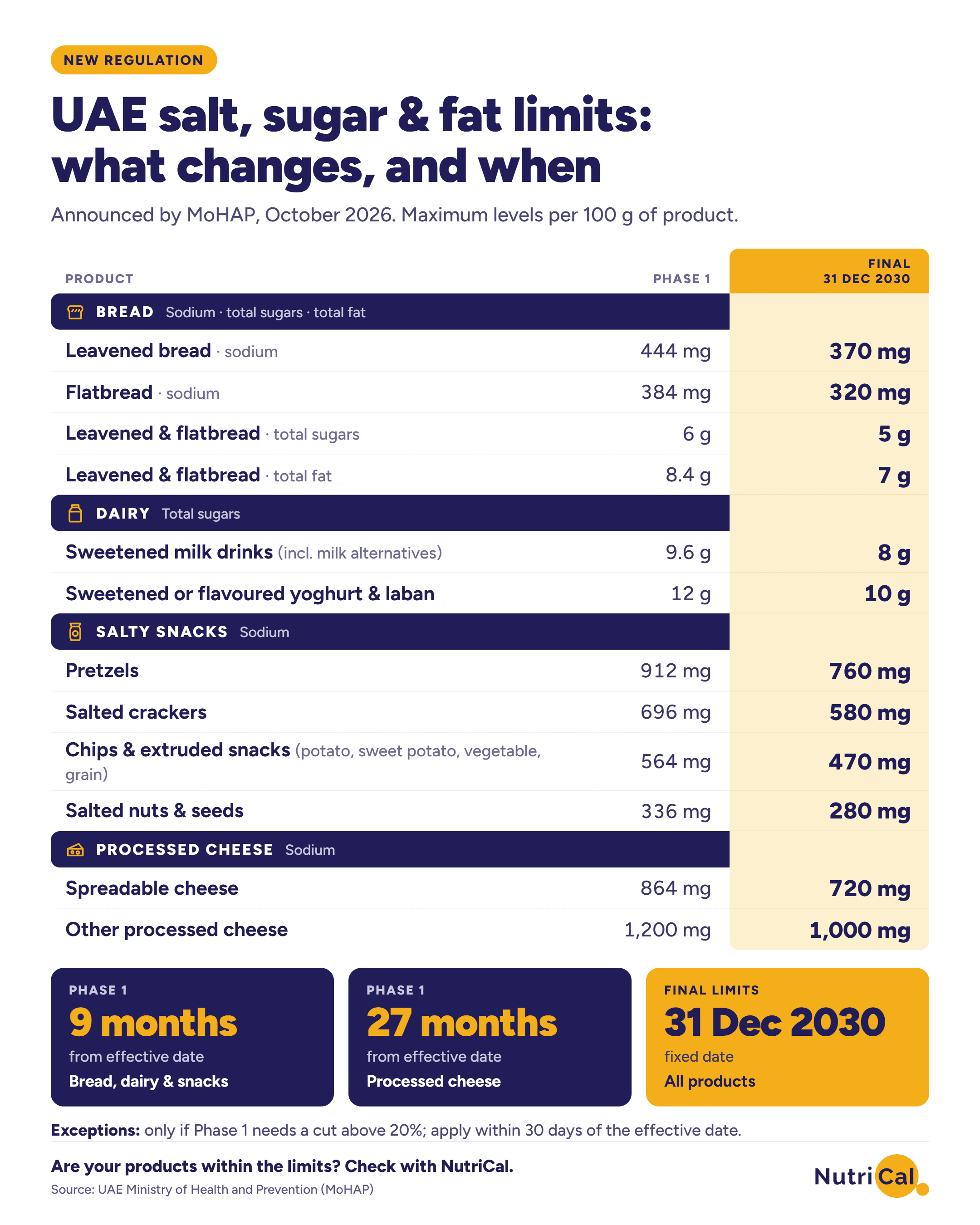
Leavened bread: Sodium / total sugars / total fat. Phase 1: 444 mg / 6 g / 8.4 g. Final: 370 mg / 5 g / 7 g.
Flatbread: Sodium / total sugars / total fat. Phase 1: 384 mg / 6 g / 8.4 g. Final: 320 mg / 5 g / 7 g.
Sweetened milk drinks (incl. milk alternatives): Total sugars. Phase 1: 9.6 g. Final: 8 g.
Sweetened or flavoured yoghurt and laban: Total sugars. Phase 1: 12 g. Final: 10 g.
Salted crackers: Sodium. Phase 1: 696 mg. Final: 580 mg.
Salted nuts and seeds: Sodium. Phase 1: 336 mg. Final: 280 mg.
Pretzels: Sodium. Phase 1: 912 mg. Final: 760 mg.
Extruded snacks and chips (potato, sweet potato, vegetable, grain): Sodium. Phase 1: 564 mg. Final: 470 mg.
Spreadable processed cheese: Sodium. Phase 1: 864 mg. Final: 720 mg.
Other processed cheese: Sodium. Phase 1: 1,200 mg. Final: 1,000 mg.
These limits are as reported in MoHAP's October 2026 announcement. Check the current figures with MoHAP before you reformulate, test or relabel.
The phase-one numbers are exactly 20% above the final numbers in the table. That is useful for planning, but it is not a separate legal rule.
Deadlines: Group 1 must meet phase-one limits within up to nine months from the date the resolution takes effect. Group 2, processed cheese, has up to two years and three months. All final limits apply by 31 December 2030. Phase-one deadlines run from the legal effective date, which is not automatically the 6 October announcement date.
Transition stock: Only products manufactured or imported before the resolution takes effect may be sold for up to one year from that date, or until expiry, whichever comes first. This is not a general extension for all old-formula stock.
Exceptions: A phase-one exception may be available where reaching the phase-one limit would require a reduction of more than 20% of the product's established level. Example: 520 mg sodium to 384 mg requires a 26.2% cut. That meets the numerical test, but it only means the business may apply; approval is not automatic.
Eligible products must have been manufactured, imported or traded in the UAE before the effective date. Applications must be filed within 30 days and include the technical data, registered label data and accredited-lab results required by the resolution. If approved, the business must still reduce the ingredient by at least 20% during phase one and meet the final limit by 31 December 2030.
Enforcement: MoHAP, federal and local health authorities and other relevant bodies will monitor compliance. The resolution covers handling stages from production through sale. It lists warnings, AED 5,000–500,000 fines, closure up to six months (renewable), and licence or approval cancellation; the official announcement says the violation schedule will be issued separately. Export-only products are excluded unless traded in the UAE.
How this differs from Abu Dhabi's SEHHI requirements
The national rule controls what selected packaged products may contain; SEHHI controls which healthier menu options eligible Abu Dhabi outlets must offer.
The UAE reformulation resolution is a product rule. It sets maximum nutrient levels for selected packaged categories across the UAE, in two phases.
Abu Dhabi's DCT Circular 7/2026 is a menu and service rule. From 1 October 2026, eligible tourism-licensed hotel restaurants and food and beverage outlets must offer at least one SEHHI-qualifying healthy option in each adult menu category, and at least 50% of children's menu items must qualify. SEHHI helps identify healthier menu choices; it does not replace the national product limits.
Abu Dhabi also has separate high fat, salt and sugar (HFSS) placement standards for larger supermarkets and online grocery platforms, with mandatory compliance from 1 January 2027. Those standards restrict prominent placement, not the sale of the product. Keep these checks separate: national reformulation, SEHHI menu eligibility, Nutri-Mark grading, and Abu Dhabi placement.
Done before, but never this fast
The UAE already uses other nutrition tools, including excise taxes on some drinks, the 2026 tiered sugar-sweetened beverage tax, voluntary or programme-based reformulation work, and Abu Dhabi's Healthy Living measures. Those tools change price, information or the shopping environment. This resolution is different because it sets product-level maximums.
Other markets show what works, and how long it takes:
UK (2003–2011): Voluntary salt targets, 80+ food groups. Lead time: No legal deadline. Outcome: Salt intake down 15% (9.5 to 8.1 g/day); progress stalled once pressure eased after 2011.
South Africa (R.214): Mandatory sodium caps, two phases. Lead time: About 3 years (published 2013, enforced June 2016). Outcome: Roughly two-thirds of covered foods compliant at the phase-one deadline.
Saudi Arabia (SFDA): Mandatory 1 g salt per 100 g bread (about 390 mg sodium), enforced 2019. Lead time: Phased, with extensions. Outcome: Regional bakeries already reformulated.
UAE (2026): Mandatory caps, two phases. Lead time: 9 months for Group 1. Outcome: To be determined.
The practical lesson is time. Nine months for Group 1 is short for some reformulation, validation and label-change programmes. The UAE's final 370 mg sodium cap for leavened bread is slightly lower than Saudi Arabia's on a like-for-like basis.
The R&D and QA bottleneck
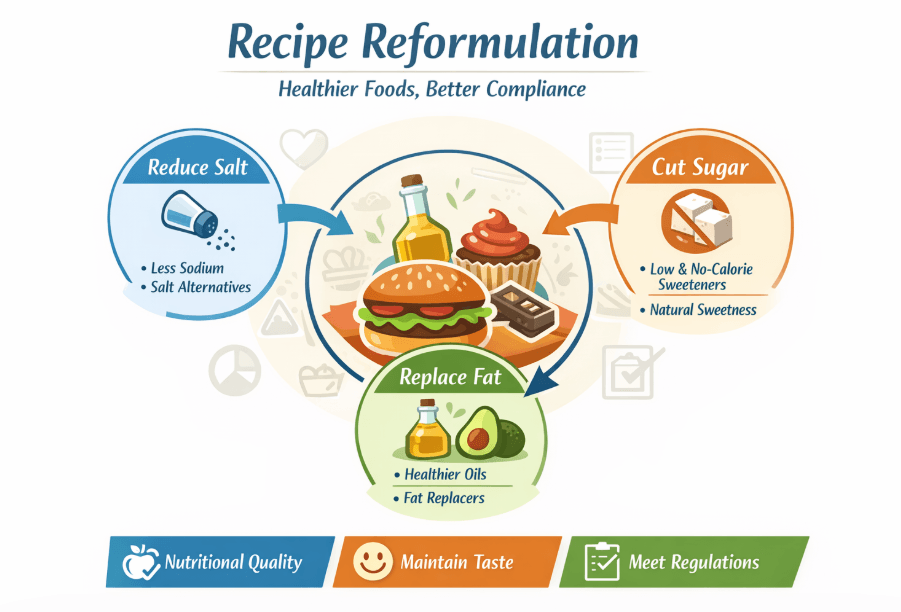
Salt, sugar and fat are part of how products work. Reducing them can affect taste, texture, fermentation, shelf life and cost.
Shelf life: Reducing salt or sugar can change water activity and preservation. Treat this as an R&D risk to test, not as a guaranteed outcome for every product. For imported SKUs, recheck shelf-life and transport assumptions.
Bread and flatbread: Lower sodium can change dough handling, proofing and colour. Validate the recipe and line settings. Potassium chloride may help in some formulas, but taste must be checked.
Processed cheese: The cap is sodium. Emulsifying salts affect hydration, melt and spread. Any reformulation needs texture, melt and sensory checks.
Sweetened dairy and laban: The cap is total sugars, so naturally occurring lactose counts. This leaves less room for added sugar. Check sweetness and acidity, especially in laban.
Savoury snacks: Seasoning placement and particle size can help reduce sodium while keeping salt perception, but this must be verified in sensory tests.
Testing load: Every reformulation needs updated nutrition data and internal quality review. Some products will also need lab analysis, shelf-life or challenge work, sensory approval and a new label.
Next steps for R&D teams
Decide on exceptions quickly. Screen SKUs against the phase-one limits and the more-than-20% test. Do not miss the 30-day window once the legal effective date is confirmed.
Build an exposure register. For each SKU, store category, market, manufacturer, recipe or label version, current sodium, sugars and fat per 100 g, the data source, gap to phase one, gap to the final limit, deadline and owner.
Design towards final limits. Use phase one as a transition point, not the product target.
Ask suppliers for evidence. Request current specifications, nutrition panels, lab reports where available, recipe or version dates and reformulation plans. Track who owns each product.
Start validation early. Shelf-life, challenge and sensory work may take months; the need depends on the product and the change.
Plan stock run-down. Track manufacturing or import dates, expiry and country of sale. Do not assume every old-formula batch gets the one-year window.
Change the label with the recipe. Link recipe, nutrition calculation, Nutri-Mark, Arabic label, product registration where applicable, and approval in one change-control record.
How nutrition software can help: consulting plus platform
This is not only a calculator problem. Teams need a versioned compliance record for each SKU: the rule, market, phase, data source, recipe version, evidence, deadline and approval status.
Your bottleneck → what NutriCal does:
SKU scope and deadline: Classify category, market and phase; show pass, near limit or fail
Reformulation scenarios: Model recipe changes before a trial batch and show nutrient trade-offs
Supplier data: Store source, date, unit, lab or specification file and data quality for each value
Exception evidence: Track eligibility, deadline, application status and required evidence
Change control: Link recipe, calculation, label, Nutri-Mark or SEHHI status and approval
Rule versioning: Store source, effective date, jurisdiction, category and phase; keep the history
NutriCal helps teams find exposed SKUs, test reformulation scenarios, organise supplier evidence and keep recipes, nutrition calculations and labels aligned.
FAQ: UAE sodium, sugar and fat limits
What are the new UAE limits? The resolution applies to selected packaged products. It sets limits on sodium and total sugars and, for bread, total fat, per 100 g. The covered categories and two-phase deadlines are listed above.
Does it apply to imported food? Yes. It covers qualifying packaged food made locally or imported, including products handled by free-zone businesses. Food made solely for export is exempt unless traded in the UAE.
When must products comply? Group 1 has up to nine months from the legal effective date; processed cheese has up to two years and three months. Final limits apply by 31 December 2030.
What are the penalties? The announcement lists a warning, an AED 5,000–500,000 fine, closure up to six months (renewable), and licence or approval cancellation. Penalties depend on severity, circumstances and recurrence; the detailed list is to be issued separately.
Is this the same as Nutri-Mark? No. Nutri-Mark is an A–E front-of-pack grading initiative. The reformulation resolution sets maximum levels. A product may have a poor grade without being banned; a targeted product above the legal limit cannot be traded after the deadline.
Can I get an exception? Possibly for phase one, if the more-than-20% test is met and the application is filed within 30 days of the legal effective date. Approval is not automatic and the 2030 final deadline does not move. Check the application process and current requirements directly with MoHAP.
Disclaimer
This article is for general information only. It is not legal, regulatory or technical advice, and it does not create a consultant–client relationship. It is based on public announcements and media reports available in October 2026. The final resolution, technical guidance, violation schedule and emirate-level implementation rules may differ from what is described here and may change over time.
Before making any decision on product formulation, labelling, stock, exceptions or market access, confirm the current requirements directly with the UAE Ministry of Health and Prevention (MoHAP) and the relevant emirate authority (for example, Dubai Municipality, ADAFSA, ADPHC or DCT Abu Dhabi). For decisions about specific products, get advice from a qualified regulatory or legal professional. NutriCal accepts no liability for actions taken based on this article.
Sources
Khaleej Times: UAE sets new sodium, sugar and fat limits (6 Oct 2026)
WAM: MoHAP starts implementing resolution setting caps (6 Oct 2026)
Gulf News: UAE sets up to Dh500,000 fine for food exceeding limits
Gulf News: UAE to introduce new salt regulations
Freyr: UAE front-of-pack (Nutri-Mark) WTO notification
Lexis Middle East: Abu Dhabi mandatory Nutri-Mark labelling
He et al., BMJ Open: Salt reduction in England 2003–2011
Peters et al., Nutrients: South African packaged food sodium at the 2016 deadline
SFDA: Saudi Arabia among countries reducing salt consumption

Government Partnership
Coming Soon















Frequently Asked Questions


NutriCal provides comprehensive nutritional analysis beyond calorie counts, encompassing allergens, meal types, and customized food labels. You can also effectively manage recipes, tailor menus, and generate insightful reports.
NutriCal is an online platform accessible from anywhere with an internet connection. Our services have a global reach, with a strong focus in the GCC region.
NutriCal collaborates with a diverse range of establishments, including food brands, suppliers, retail chains, and restaurants in the GCC.
Absolutely! NutriCal offers a complimentary trial period. Reach out to us to initiate your trial experience on our platform.
For detailed pricing information, please get in touch with our dedicated sales team. Our pricing plans are flexible and tailored to suit your specific business requirements.
We provide both monthly and annual subscription plans, granting you the choice to select the payment option that aligns best with your preferences.
NutriCal allows seamless integration of missing ingredients through credible data sources, ensuring a complete and personalized database.
NutriCal's data originates from reputable sources such as USDA and undergoes rigorous theoretical analysis, ensuring utmost precision in nutritional calculations.